What are Trump Accounts? A Parent-Friendly Guide to the New Child Savings Program
As the Trump Account Summit takes place in Washington, D.C. on Wednesday, January 28, we at EveryLife wanted to make sure you and your family feel prepared—and empowered—to take advantage of any opportunity to help set your kids up for the future.
Imagine opening an investment account for your child and starting with $1,000 already deposited to help them build long-term financial security from day one. That’s the idea behind Trump Accounts, a new federally-backed program designed to help American children under 18 start building a stronger financial foundation early in life.
A strong start matters—financially, emotionally, and in every way that shapes a child’s future. Here’s a simple, parent-friendly guide to Trump Accounts: how they work, how to open one, and whether it could be a good fit for your family.
What are Trump Accounts?
Trump Accounts are federally sponsored investment accounts created to help American children under 18 build long-term financial security. Think of them as a future-focused savings tool with an investing component—something families can add to over time, with the goal of giving kids a stronger foundation as they grow. Parents can contribute, and in some cases, employers may be able to contribute, offering another way to build momentum for a child’s future.
The program was introduced through the One Big Beautiful Bill Act, signed into law in July 2025. Under the original legislation, eligible newborns receive a one-time $1,000 seed contribution from the U.S. Treasury to start their account.
A major expansion through philanthropy
In early December 2025, philanthropists Michael and Susan Dell pledged $6.25 billion to help expand the program—funding an additional $250 contribution per child for millions of children, particularly younger kids who weren’t eligible for the federal newborn deposit. Reports describe eligibility tied to ZIP-code–based criteria (using local income measures) and other program rules.
Then on December 17, 2025, billionaire investor Ray Dalio (founder of Bridgewater Associates) and his wife Barbara announced a similar pledge for Connecticut—committing $250 per child for children under 10 in Connecticut ZIP codes where the median household income is under $150,000.
Inspired by these gifts, Treasury Secretary Scott Bessent announced a “50 State Challenge”—an effort to encourage philanthropists across the country to step in and help seed more children’s accounts state by state.
How do I know if my child qualifies for a Trump Account (and the seed money)?
Here’s the encouraging part: any child under 18 can have a Trump Account opened for them. The bigger question most parents are asking is whether their child qualifies for the free seed money that helps jumpstart the account.
When Trump Accounts were first introduced, the government’s seed deposit was specifically tied to certain birth years. But in late 2025, several major philanthropic gifts expanded the program—and that’s why you may now hear that older children could qualify for a deposit too.

Below is the simplest way to break it down:
Eligible for the $1,000 seed deposit (newborn contribution)
Your child qualifies for the full $1,000 federal contribution if they:
- Were born between January 1, 2025 and December 31, 2028
- Are a U.S. citizen
- Have a Social Security number
And here’s a relief for many families: this $1,000 deposit does not require an income minimum or income cap.
What if my child is older? The $250 seed deposit expansion
With the philanthropic expansion, Trump Accounts are available to even more children—especially those who were too old to qualify for the newborn deposit.
That pledge included a one-time $250 deposit, and according to White House materials and major reporting, eligibility is expected to prioritize children who:
- Are under age 10
- Live in ZIP codes where the median household income is under $150,000
- Fall within the first 25 million eligible children identified through the program
In other words: this part of the program is designed to make sure kids outside the newborn window still have a chance to get a meaningful head start.
Separate pledge for Connecticut families
While Connecticut families will have an additional option all their own it’s not yet clear whether a child could qualify for both the Dell-backed $250 contribution and the Dalio Connecticut contribution. As the program continues rolling out and more official guidance becomes available, we’ll keep watching for updates so families can make the most informed decision.
How Trump Accounts Work
Once your child’s Trump Account is opened, it’s designed to grow with them over time. Instead of functioning like a typical piggy bank, a Trump Account works more like a long-term investment account—meaning the money inside can grow year after year with the goal of building a stronger financial foundation for adulthood.
Parents can add to the account gradually, and in some cases employers and approved organizations may be able to contribute too. The big idea is simple: give families the opportunity to start early—even with small amounts—and let time do the heavy lifting.
How much money does a Trump Account start with?
That depends on whether your child qualifies for a seed contribution:
- Eligible newborns may receive a one-time $1,000 deposit from the U.S. Treasury to kickstart their account.
- Some children under age 10 may qualify for a one-time $250 deposit through philanthropic expansion efforts.
- Other children under 18 may still open an account even without seed money—starting at $0—and families can contribute over time as they’re able.
Even if your child starts at zero, opening the account early still creates a place for future contributions to grow.
How much can families contribute each year?
Trump Accounts are built to allow parents to keep it simple and flexible. According to White House program materials:
- Parents and caregivers can contribute up to $5,000 per year (after-tax dollars).
- Employers may be able to contribute up to $2,500 per year, and those contributions are designed not to count as taxable income for the employee.
- Certain government entities and charitable organizations may also be allowed to contribute under IRS rules, with additional guidance expected as the program rolls out.
How is the money taxed?
One reason Trump Accounts are getting so much attention is that the money is designed to grow tax-deferred.
That means:
✅ the money in the account can grow over time
✅ you generally don’t pay yearly taxes on investment growth
➡️ taxes typically come later, when money is withdrawn
If “tax-deferred” feels like financial jargon, don’t worry—we’ll define these terms clearly in the glossary below.
When can your child use the money?
Trump Accounts are meant to be long-term, so kids generally won’t be pulling money out during childhood.
Here’s the simplest way to think about it:
- Before age 18
- Withdrawals are typically not allowed, with limited exceptions (including an ABLE rollover at age 17 for eligible individuals with disabilities).
- After age 18
- The account begins to function more like a traditional IRA-style account, meaning:
- withdrawals are generally taxed as income
- withdrawing early (before age 59½) may come with a 10% penalty, unless the funds are used for certain qualifying life expenses, such as education, a first home purchase, starting a business, or birth/adoption of a child
In other words: this isn’t meant to be “quick cash.” It’s built for bigger future moments.
What can the money be used for?
The program is designed to support major life milestones—things that help young adults build stability as they step into adulthood.
- Higher education expenses
- A first-time home purchase (up to $10,000)
- Starting a business (up to program limits)
- Birth or adoption of a child (up to program limits)
These guardrails are meant to keep the account focused on building a future—not just spending.
How is a Trump Account different from an IRA?
A Traditional IRA or Roth IRA is usually something adults use to save for retirement—often tied to earned income and long-term tax benefits.
A Trump Account isn’t exactly a retirement account, but it’s structured in a way that becomes similar to a traditional IRA after age 18, especially when it comes to how withdrawals are taxed and when penalties might apply.
The biggest difference is the purpose:
Trump Accounts are designed so children can begin building long-term savings early in life—without needing employment income to start.
How to Open a Trump Account
Opening a Trump Account is designed to be simple—even if you’re not a “finance person.” The key thing to know is that enrollment happens through the IRS, and it’s tied to a new form created specifically for this program.
Here’s what parents can expect as the rollout continues.
Step 1: Complete IRS Form 4547
According to the IRS, Form 4547 (Trump Account Election(s)) is the form used to:
- Open an initial Trump Account for an eligible child
- Request the one-time $1,000 federal seed contribution (if your child qualifies)
You can view the IRS information page for the form here:
https://www.irs.gov/forms-pubs/about-form-4547
And the official IRS instructions for completing the form here:
https://www.irs.gov/instructions/i4547
Important: Opening the account and requesting the $1,000 seed money are two separate elections on the IRS form. If your child qualifies for the newborn deposit, you’ll need to check the box requesting the pilot contribution—it isn’t automatic just because you opened the account.
Form 4547 also lets you make elections for up to two children on one form (and you can file additional forms if you have more)
Step 2: File it as part of your tax process (or use the online option when it opens)
The IRS and major financial institutions have explained that parents will be able to enroll by filing Form 4547—and that an online enrollment option is also expected to be available through trumpaccounts.gov beginning in July 2026.
A quick note: While parents can begin filing Form 4547 with their 2025 tax returns or prepare to enroll through the online portal, actual funding and contribution activity is expected to begin around July 4–5, 2026, according to current guidance.
In other words, families can take steps to open and elect accounts ahead of time, with contributions and account activity ramping up once the program officially goes live.
Step 3: Your child’s account is activated through a participating financial institution
Once the election is processed, the account will be opened and funded through a participating financial institution that will hold and invest the funds.
(Some logistical details—like which specific institutions will be involved—may continue to roll out as the program fully launches.)
How Trump Accounts Could Help Improve Your Child’s Financial Future
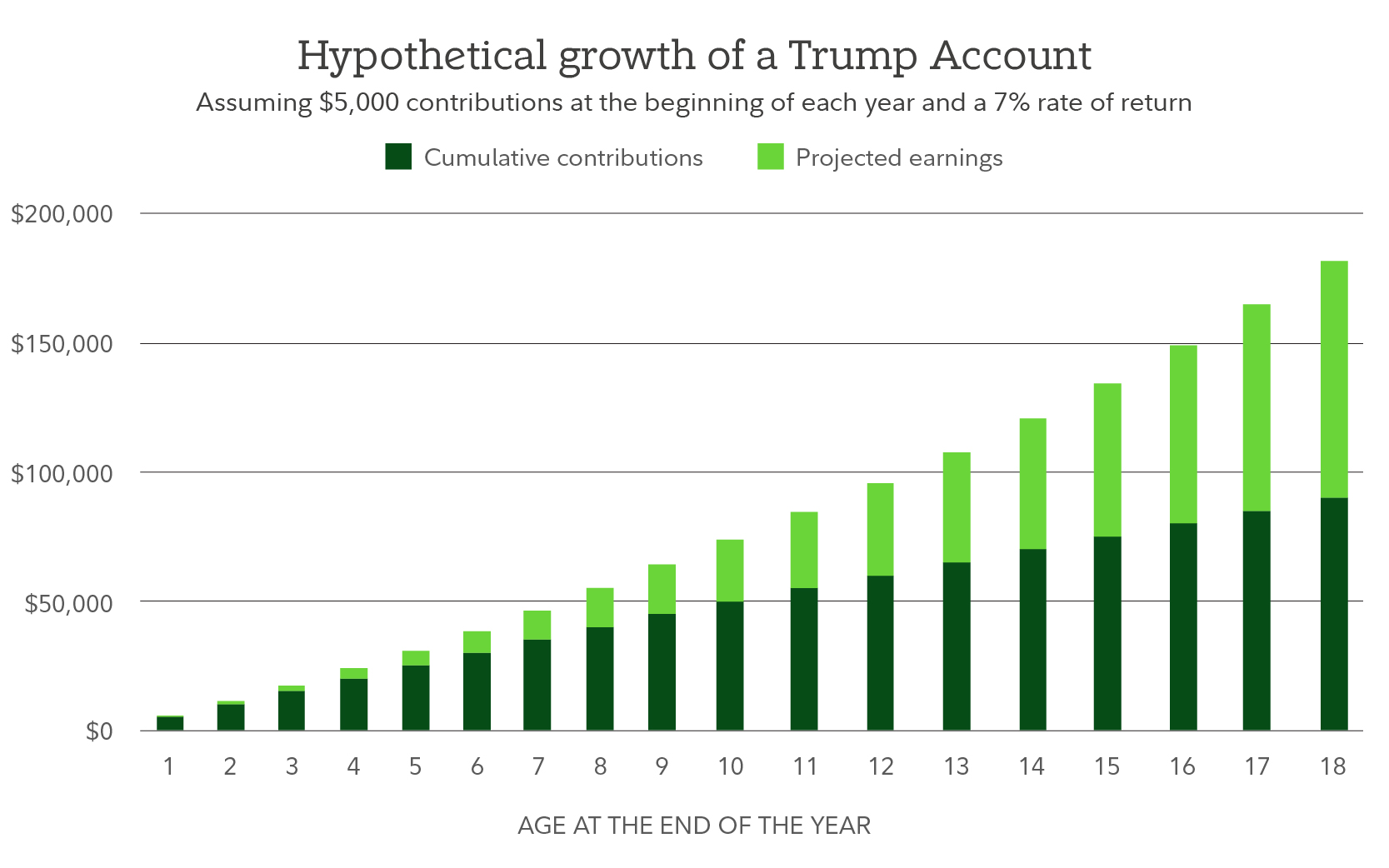
Of course, these numbers aren’t promises—they’re just examples meant to show the power of time + consistency when an account is started early.
To give you a simple picture of why starting early matters, some outlets have shared illustrative examples using a 7% average annual return (which is a common long-term stock market assumption—though real returns vary). In one example, if a family contributed the maximum $5,000 each year on top of the seed money, the account could grow to roughly $6.95 million (pre-tax) by age 65. And even if a family never added anything beyond the initial deposit, that seed money alone could still grow to around $93,000 by age 65.
Some things to remember
Before you decide what to do, here are a few parent-friendly reminders to keep expectations grounded and hope realistic:
- Starting early often matters more than starting big.
Starting early turns time into your biggest advantage. Opening an investment account for a newborn can create a safer financial future, letting compound growth do the heavy lifting over the years—and helping expand opportunity down the road. - You don’t have to max it out to make it meaningful.
Most families won’t contribute $5,000 every year—and that’s okay. Even occasional contributions can add up over time, especially with long-term investing. - This isn’t meant to cover today’s diaper-and-grocery season.
Trump Accounts are built for the future. Think of it as a “later” fund for big life moments like:
- Education and training
- First-home savings
- Emergencies
- Long-term stability (even retirement)
- Market ups and downs are normal.
Because this is an investment account, the balance will rise and fall. That can feel uncomfortable—but historically, long-term investing has tended to reward patience more than perfect timing.

(Above) Quick Comparison of Savings Accounts for Minors
Frequently Asked Questions:
- Do I need to open a Trump Account right away after my baby is born?
You don’t have to open it immediately—but opening sooner can help you avoid missing steps (especially if your child is eligible for the $1,000 pilot contribution, which must be requested on the IRS form).
Learn more: IRS Form 4547 instructions (how to elect the account + request the $1,000).
- What if I can’t afford to contribute much right now?
That’s okay. Trump Accounts can still be opened even if you don’t contribute right away, and the account is designed to grow over time. Some families may also qualify for seed money depending on eligibility.
Learn more: Official program site overview.
- Can grandparents (or other family members) contribute?
In many cases, yes—contributions can come from more than just parents, as long as total annual contributions follow the program’s limits and rules.
Learn more: Savingforcollege explainer (contributions + limits).
- Will this affect my child’s financial aid later on?
It might, depending on how future aid formulas treat these accounts and your family’s overall financial picture. If this is a big concern, consider asking a tax pro or financial aid advisor as guidance develops. (Most official Trump Accounts guidance focuses on eligibility, elections, and tax rules—not FAFSA treatment yet.)
Learn more: Fidelity’s parent-friendly overview (includes planning considerations).
- Is this meant to replace a 529 plan or a regular savings account?
Not usually. Many families will use a Trump Account as one tool alongside things like emergency savings and (for education goals) a 529.
Learn more: Franklin Templeton comparison to other savings options for minors.
- What happens if the market goes down?
Because the money is invested, balances will go up and down. That’s normal for investing. The goal here is long-term growth—time is the advantage.
Learn more: https://trumpaccounts.gov
- What if the rules change as the program rolls out?
That’s normal for a brand-new federal program—guidance and processes can get refined over time. The best approach is to follow official updates and check the IRS instructions when you’re ready to enroll.
Learn more: IRS newsroom guidance on Trump Accounts + the IRS Form 4547 instructions.
Helpful Terms:
We want this to feel simple and empowering. Here are a few quick definitions so you can focus on what matters—making wise choices and building a stronger future for your family.
Investment account
An account where your money is invested (often in the stock market) so it can grow over time. Unlike a regular savings account, the value can go up and down.
Federally backed / federally sponsored
A program created and supported through the U.S. government (not just a private company or bank).
Seed money / seed contribution
A one-time “starter” deposit to help begin the account—like the $1,000 for eligible newborns or the $250 deposits tied to philanthropic expansion.
U.S. Treasury
The federal department that manages government money—often referenced when the government is funding or distributing program contributions.
Eligible / qualifies
Meets the requirements for the account or for the free seed deposit (age, citizenship, Social Security number, and sometimes location-based criteria).
Social Security number (SSN)
A government-issued number used to identify individuals for taxes and benefits. It’s required for enrollment.
Median household income
The “middle” income in an area—half of households earn more than that number and half earn less. (Used in some ZIP-code eligibility rules.)
ZIP-code–based criteria
Eligibility rules that depend on where you live (your ZIP code), often using local income measures.
After-tax dollars
Money you contribute after you’ve already paid income taxes on it (like money from your paycheck that hits your bank account).
Employer contribution
Money your employer adds on your behalf. In this program, employer contributions may be allowed up to certain limits.
Taxable income
Income the government counts when calculating how much tax you owe. (Some contributions may not count as taxable income under program rules.)
Tax-deferred
You typically don’t pay taxes each year on the account’s investment growth while the money stays in the account. Taxes may apply later when money is withdrawn.
Investment growth / earnings
The increase in value over time—often from gains in investments, dividends, or interest.
Withdrawal
Taking money out of the account.
Penalty
An extra fee the government may charge if money is withdrawn early (on top of any taxes due), depending on the rules and the reason for the withdrawal.
Qualified expenses
Specific approved uses for the money that may avoid penalties (examples in your blog: higher education, first-time home purchase up to $10,000, starting a business, birth/adoption).
First-time home purchase
A common “qualified use” category in tax-advantaged programs; often includes a limit (your blog notes up to $10,000).
Traditional IRA
A retirement account where money can grow tax-deferred, and withdrawals are generally taxed later. (Your blog compares Trump Accounts to this after age 18.)
Roth IRA
A retirement account that works differently than a traditional IRA: you generally contribute after-tax money, and qualified withdrawals can be tax-free later.
Earned income
Income from working (wages, salary, tips). Many IRAs require earned income to contribute—your blog notes Trump Accounts are designed so kids can start without needing a job.
ABLE account / ABLE rollover
A type of savings account for eligible individuals with disabilities. Your blog mentions a limited exception involving an ABLE rollover at age 17.
Average annual return (example: 7%)
A common “illustration” number used to show what could happen over time in the market. Not guaranteed—real returns change year to year.
Compounding / compound growth
When growth builds on prior growth—your money earns returns, and then those returns can earn returns too. This is why time matters so much.
Market risk / market ups and downs
Because investments move with the stock market, account balances can rise and fall—especially in the short term.
529 plan
A savings plan designed for education expenses. Many families use these alongside other tools because 529s have education-focused tax benefits and rules.